
The Invisible Surcharge: Why You’re Paying a 40% "Label Tax" on Your Suits

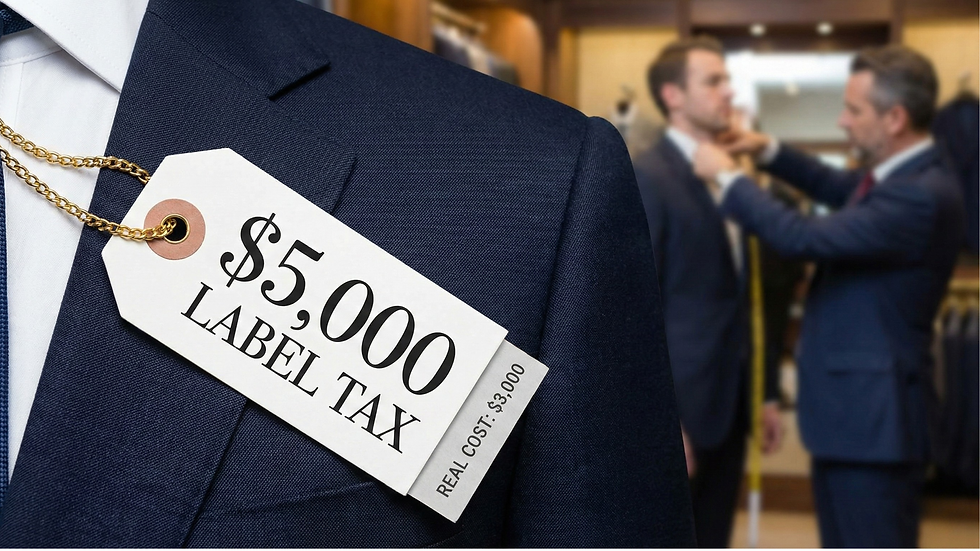
The Label Tax: Why You're Paying 40% More for a Name on Your Suit
There is a number nobody in the luxury suit industry wants you to know.
It's not the thread count. It's not the cost of the wool. It's not even the cost of the craftsmanship.
It's how much of what you're paying has absolutely nothing to do with the garment.
Call it the Label Tax — the invisible surcharge built into every luxury suit from a brand that spends millions annually making sure you recognize their name. And the way that marketing budget gets funded is simple: you pay it.
What You're Actually Buying When You Buy a Name
Walk into a high-end showroom and pull a suit from a house like Loro Piana, Zegna, or Scabal. What you're looking at isn't just fabric. You're looking at billboards in Milan, full-page spreads in GQ, celebrity partnerships, flagship retail locations on streets where the rent alone costs more than most people's annual salary.
All of that lives in the price tag. And none of it improves the garment.
These mills produce exceptional textiles. That part is true. But the name stamped on the selvage of the cloth adds a premium that has nothing to do with what the fabric actually does — how it drapes, how it holds its shape, how it performs over years of wear. You are paying for the story. Not the science.
What the Industry Doesn't Want You to Know
There are mills in Biella, Italy and Huddersfield, England producing fabric that is identical to — and in many cases superior to — what the brand-name houses are selling. The difference is they don't buy advertising. They don't sponsor events. They don't build mythology around their name.
They just make extraordinary cloth.
Because they have no marketing infrastructure to fund, they have no marketing costs to pass on. The fabric reaches you at the price it should be — based on its quality, not its story.
This is what the industry calls insider sourcing. And it's what separates a clothier who is truly working in your interest from one who is selling you a brand experience dressed up as expertise.
The Real Cost Breakdown
A $5,000 branded suit is not five times better than a $1,000 suit. In most cases, the actual difference in fabric and construction quality is far smaller than the price gap suggests. What fills that gap is brand equity — and brand equity benefits the label, not the person wearing it.
When you remove the Label Tax, the math changes entirely. The same caliber of fabric, the same level of artisan handwork, the same drape and durability — sourced from a performance-driven mill rather than a marketing-driven one — can cost significantly less. Which means instead of one branded suit, you're building two garments of equal or greater quality.
That's not a discount. That's a smarter allocation of the same investment.
What Craftsmanship Actually Looks Like
The quality of a garment lives in its construction — the architecture of the suit. How the canvas is built. How the shoulders are set. How the lining moves. How the seams hold over years of wear. None of that has anything to do with whose name is on the fabric.
Artisan tailoring done at the highest level produces a garment that performs regardless of which mill the cloth came from — as long as the cloth meets the standard. And that standard is set by the clothier, not the brand.
At William Wilson Clothing, the standard doesn't change based on the label. It's set by the work itself.
Frequently Asked Questions
What is the Label Tax in luxury suits? The Label Tax is the portion of a luxury suit's price that pays for brand marketing, retail overhead, and name recognition — not fabric quality or craftsmanship. It can account for 30 to 40 percent of the total price of a branded garment.
Are luxury suit brands like Loro Piana and Zegna worth the price? Their fabrics are genuinely high quality. But a significant portion of their price reflects marketing investment, not material superiority. There are mills producing equivalent and sometimes superior cloth without the brand premium attached.
What are insider mills and why don't I know about them? Insider mills are textile producers in regions like Biella, Italy and Huddersfield, England that supply fabric to the trade without investing in consumer marketing. Because they don't advertise, they don't need to pass marketing costs on through the price. They are well known among serious clothiers and largely unknown to the public — by design.
Does using unbranded fabric mean lower quality? No. Fabric quality is determined by fiber content, weave structure, finishing process, and mill craftsmanship — none of which require a recognizable brand name. Many unbranded mill fabrics outperform their branded equivalents in durability and drape.
How much can I save by avoiding the Label Tax? Enough to build two high-quality garments for the price of one branded suit. That's not a compromise — it's a more intelligent way to build a wardrobe.
Why don't more clothiers talk about this? Because many clothiers profit from selling branded fabrics at a markup. Transparency about the Label Tax is not in their financial interest. It is in yours.
The Bottom Line
The Label Tax is real. It is built into every suit from a brand that has spent decades teaching you to trust their name over your own judgment.
When you learn to evaluate cloth on its merits — not its marketing — the entire economics of building a wardrobe changes. You stop funding someone else's brand and start investing in your own.
That's not anti-luxury. That's what luxury actually looks like when nobody is selling you a story.


Comments