
You Don't Need a Tailor. You Need a Partner.

Most people come to a clothier for a suit.
My clients come for something different.
They come because they understand that clothing isn't a purchase — it's a strategic tool. And they want someone managing that tool with the same precision and intentionality they bring to every other area of their life.
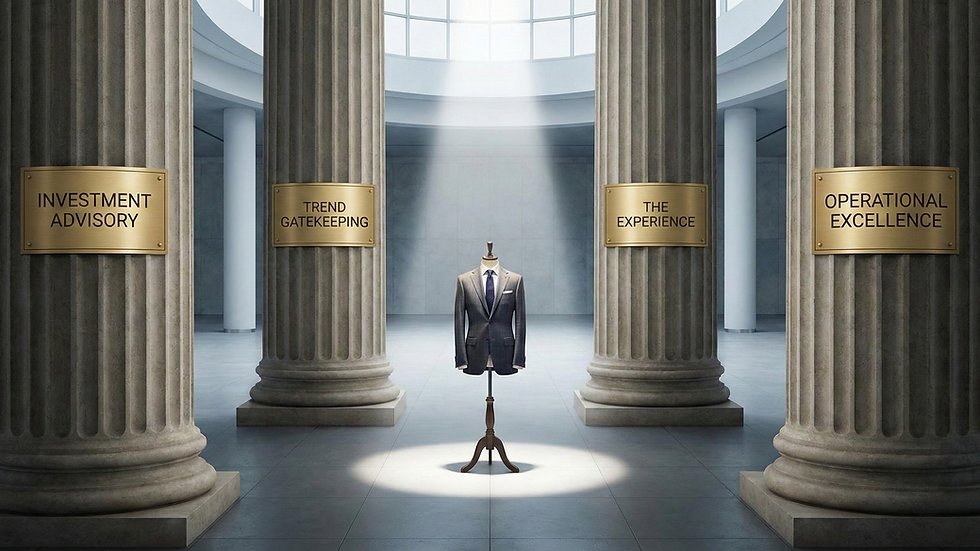
That's what this partnership is built on. Four pillars. Non-negotiable. Applied to every client, every garment, every decision.
Pillar One: Investment Advisory
A wardrobe is not a collection of clothing. It is a portfolio.
Every piece you own either appreciates or depreciates in terms of the authority, credibility, and social capital it generates for you. My job is to make sure every dollar you invest with me works — not just on the day you wear it, but across every room you walk into for years to come.
That means distinguishing between blue chip pieces — the foundational garments that never lose relevance and pay dividends indefinitely — and high growth assets — the pieces that position you ahead of where you're going, not just where you are.
I am not here to sell you something that looks good today. I am here to advise you on what builds your position over time. There is a meaningful difference between those two things, and most clothiers aren't having that conversation.
Pillar Two: Trend Gatekeeping
The most expensive mistake you can make in building a wardrobe is chasing a trend that dies in eighteen months.
Luxury retail brands do this constantly — and they do it deliberately. Seasonal turnover is their business model. Your obsolescence funds their growth.
My job is to be your filter. Before anything enters your wardrobe, it passes one question: will this be as relevant and as powerful in ten years as it is today? If the answer is anything less than yes, it doesn't make it in.
This isn't about being conservative. It's about being precise. The most commanding wardrobes in the world are built on pieces that transcend seasons — garments with a clarity of purpose that never reads as dated because they were never chasing a moment to begin with.
I protect you from the trap. That's part of what you're paying for.
Pillar Three: The Experience
The clients I work with have no time for friction.
They are not coming to me for a transaction. They are coming for a process that is as seamless, considered, and precise as the garments that come out of it. Every detail is handled. Every decision is guided. Every step is designed to take something complex and make it effortless on their end.
This is not a showroom experience. There is no browsing, no pressure, no guesswork. There is a conversation, a process, and a result — built entirely around the specific person sitting across from me.
The experience itself is part of the product. And it is built for people who understand the value of their own time.
Pillar Four: Operational Excellence
A garment that isn't ready when you need it is a liability.
Precision in the back end of this process is not optional — it is the foundation everything else rests on. By sourcing directly from performance-driven mills in regions like Biella and Huddersfield, I control the supply chain rather than depending on it. No middlemen. No delays built into a distribution model designed for someone else's timeline.
What I promise is delivered. When I promise it. At the standard I set at the beginning of the process — not an approximation of it.
Operational excellence isn't a selling point. It's the baseline. Because the people I work with make decisions at a level where the baseline has to be flawless.
Frequently Asked Questions
What does it mean to treat a wardrobe as an investment? It means evaluating every garment by the authority, credibility, and social capital it generates over time — not just by how it looks on the day of purchase. A well-built wardrobe appreciates. A poorly built one depreciates quietly, one missed opportunity at a time.
How do you protect clients from trend-driven mistakes? Every piece that enters a client's wardrobe is evaluated against one standard: relevance over time. If a cut, fabric, or silhouette won't hold its authority in a decade, it doesn't make it in. Seasonal trends are a retail strategy — not a wardrobe strategy.
What makes this partnership different from a typical tailoring experience? A typical tailoring experience is transactional — you select, they produce, you pay. This partnership is advisory. Every decision is guided by a long-term strategy built around the client's specific life, goals, and environment. The garment is the output. The thinking behind it is the product.
Who is this partnership designed for? It's designed for professionals, executives, and leaders — men and women — who understand that image is a strategic asset and want someone managing it with the same precision they bring to everything else they do.
Why does operational precision matter in custom clothing? Because the people this partnership is built for operate at a level where delays, errors, and approximations are not acceptable. A garment that isn't ready when needed, or that doesn't meet the standard set at the start, isn't just a disappointment — it's a liability.
Is this partnership available outside of Charlotte? Yes. Private consultations are available nationwide. The process is designed to be seamless regardless of location.
The Bottom Line
This is not a tailor-client relationship. It is a partnership — built on strategy, precision, and a shared understanding that the way you present yourself to the world is not a superficial concern.
It is one of the most powerful tools you have.
These four pillars exist to make sure that tool is always sharp, always relevant, and always working in your favor.


Comments